


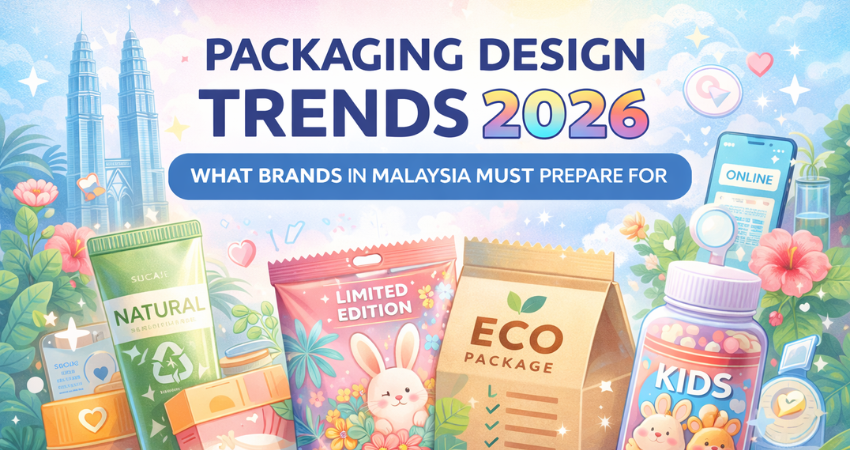
Packaging Design Trends 2026: What Brands in Malaysia Must Prepare For
Packaging design in 2026 is no longer about looking good on the shelf alone. It is about clarity, emotion, sustainability, scalability, and digital readiness.
For brands in Malaysia, packaging has become a strategic tool that directly affects purchase decisions, brand trust, and repeat sales.
As a packaging design agency in Malaysia, we see a clear shift: brands that treat packaging as a business strategy are winning, while those that see it as decoration are falling behind.
This article breaks down the top packaging design trends for 2026 and explains how your brand can prepare — strategically, not visually only.
Why Packaging Design Trends in 2026 Matter More Than Ever
Consumers today make decisions faster than ever — often within 3 seconds of seeing a product.
In crowded retail shelves and digital marketplaces, your packaging must communicate value, function, and brand positioning instantly.
This is why strategic packaging design in Malaysia is becoming a competitive advantage rather than a cost.
Brands that invest early in packaging systems, structure, and messaging will:
Stand out in saturated categories
Build trust faster
Reduce redesign costs in the long run
Scale more efficiently across SKUs
Trend 1: Emotion-Driven Packaging Design
Packaging in 2026 must connect emotionally, not just visually.
Consumers don’t buy products — they buy feelings, identity, and meaning.
Successful packaging uses colour, illustration, typography, and storytelling to trigger emotions such as:
Comfort
Trust
Excitement
Belonging
How emotional storytelling influences purchase decisions
Brands that use mascots, lifestyle visuals, or IP-inspired elements create familiarity and attachment.
This emotional connection is what turns first-time buyers into loyal customers.
Trend 2: Front-Facing Information Becomes Mandatory
In 2026, customers don’t want to flip packaging around.
They expect key information to be visible immediately:
What the product is
Who it’s for
Key benefits
Usage or category clarity
Why clarity on the front panel improves shelf conversion
Clear front-panel communication reduces confusion and increases confidence — especially for:
FMCG
Pet products
Health & wellness
Household products
Packaging that explains itself sells faster.
Trend 3: Sustainable Packaging That Still Feels Premium
Sustainability is no longer optional — but cheap-looking eco packaging hurts brand value.
In 2026, the trend is premium sustainability:
Natural textures
Minimal colour palettes
Smart material choices
Clean typography
Balancing eco-friendly materials with brand perception
Brands must show responsibility without sacrificing desirability.
Trend 4: Limited Edition & Collectible Packaging
Limited editions are no longer just marketing gimmicks — they are sales accelerators.
Brands are using:
Seasonal packaging
IP collaborations
Event-based designs
How IP collaborations and seasonal designs drive repeat sales
Well-designed limited packaging encourages:
Social sharing
Collecting behaviour
Emotional attachment
This is especially powerful in lifestyle, FMCG, and retail brands.
Trend 5: System-Based Packaging Design for Multi-SKU Brands
Brands with multiple SKUs can no longer design each package individually.
In 2026, successful brands use packaging systems:
Consistent structure
Clear hierarchy
Flexible colour or icon coding
Why scalable packaging systems matter for growing brands
System-based packaging:
Reduces production errors
Improves shelf recognition
Makes brand expansion easier
Trend 6: Packaging Designed for Digital & E-Commerce
Packaging must look good not only in real life — but also:
On Shopee & Lazada
On Instagram
In thumbnails
In unboxing videos
Designing packaging for thumbnails, social media, and unboxing
This is why brands are investing in:
Clean front visuals
Strong contrast
3D mockups & renders
Packaging in 2026 speaks directly to communities, not just markets.
Brands are designing packaging that reflects:
Local culture
Lifestyle values
Shared identity
Building emotional loyalty through identity-driven design
When customers feel represented, they trust your brand more.
Minimalist packaging doesn’t mean boring.
Typography-led designs use:
Bold fonts
Strong hierarchy
Clean layouts
Strong typography improves readability and memorability — especially from a distance.
Consumers want packaging that helps them decide faster.
This includes:
Usage icons
Feeding guides
Simple diagrams
Visual instructions
Functional clarity builds trust — especially for first-time buyers.
The biggest shift in 2026 is mindset.
Packaging is no longer decoration — it is a business tool.
Good packaging:
Increases perceived value
Reduces customer hesitation
Supports brand positioning
Improves long-term ROI
To stay competitive, brands should:
Audit existing packaging systems
Clarify brand positioning
Design for scalability
Invest in strategic design, not trends alone
At Seji Design, we don’t just design packaging — we design packaging strategies that support business growth.
From concept development to structure, mockups, and production-ready designs, we help brands build packaging that sells, scales, and lasts.
👉 View our packaging design portfolio
👉 Work with us on your next packaging strategy
